A Procession fit for a Queen
Well, heavens be, she’s done it again.
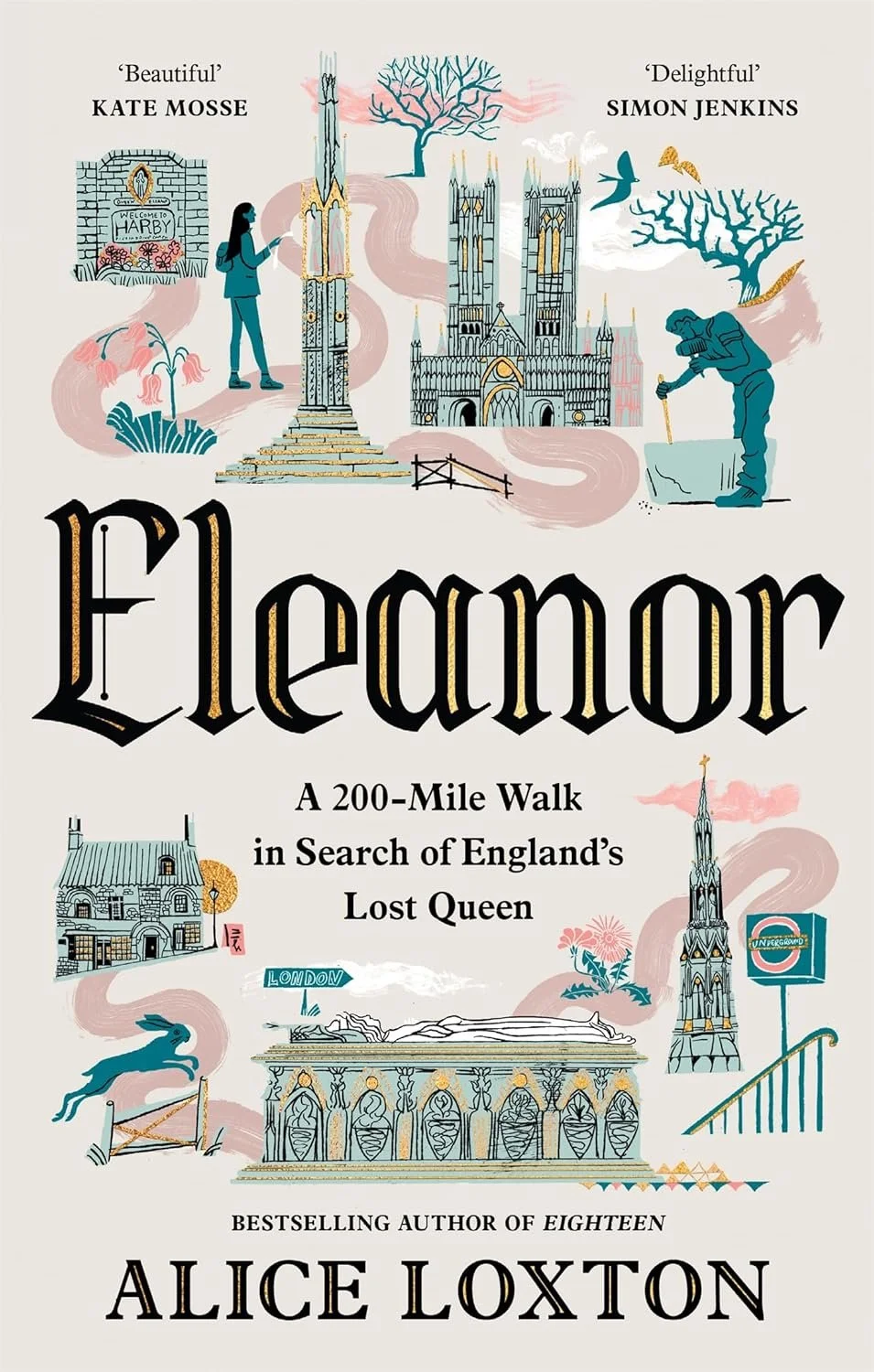
Less than two years after her delightful Eighteen: A History of Britain in 18 Young Lives, Alice Loxton whirls her readers on foot through medieval England, weaving tales of love, violence, devotion, and more historical anecdotes than three hundred pages should hold. In Eleanor: A 200-Mile Walk in Search of England’s Lost Queen, Ms. Loxton traces the cortege of Eleanor of Castle, whose death on November 28, 1290 was followed by a thirteen-day procession through the English countryside to Westminster Abbey. Ms. Loxton, inspired by her own “medieval pilgrimage” waiting in The Queue to see Queen Elizabeth II lying in state in 2022, set out to re-trace the same journey, with the same stops, on the same dates--in December, mind you--of her medieval forebears. Let no one claim Ms. Loxton isn’t dedicated to her craft.
“Lost Queen,” though, is a misnomer. While Eleanor of Castile is overshadowed by her eponymous predecessor from Aquitaine, Ms. Loxton’s journey proves that Eleanor of Castile is anything but forgotten. For one, her cortege was commemorated by twelve obelisks--Eleanor Crosses, they’re called--built by her husband, Edward I, in the four years after her death. Each marks a place, ranging from major cathedrals to obscure villages, where Eleanor’s body rested on its route to London. While only three survive today (the rest were casualties of the Reformation and the English Civil War), Ms. Loxton discovers that each location still commemorates Eleanor in its own way, whether through murals, plaques, statues, or re-created crosses. Even the Charing Cross Tube station in London greets commuters with an Eleanor wall, before they exit to see a full, Victorian Era cross on the street. When Ms. Loxton finds the “Queen Eleanor Interchange,” a roundabout on the A45 in Northampton delightful, it’s hard not to nod along with her. This Eleanor is anything but lost.
In her myriad interviews, Ms. Loxton insists that she sets out to write books that she would want to read, and that she models herself on, among others, Bill Bryson. With due respect, such a comparison sells her short. Bryson is a renowned curmudgeon, and his travel tales regularly go out of their way to bring a place or its denizens himself down a peg. Ms. Loxton, by contrast, brims with stubborn optimism and embraces her journey with fascination and joy. (In Eleanor, that is particularly necessary, since her first three days each demanded more than twenty miles of walking.) Throughout her walks, she constantly imagines her subjects walking, or even in dialogue with, her. And therein lies Ms. Loxton gift as a historian: she lingers little on the dryness of dates or the umpteen thousand battles, and instead emphasizes the emotions that must have been in overdrive during a thirteen-day funeral: love and grief. “Did the royal children weep to see their mother’s body lying in front of the high altar, finally in her place of rest? What of King Edward, that tall, lonely figure? Did he hold back tears to see his beloved Eleanor’s body, surrounded by flickering candles?” she asks. That Ms. Loxton ruminates so openly on such unknowable questions helps connect the reader with subjects that lesser authors render distant.
Like all medieval monarchs, Eleanor and Edward married as a political alliance (he was fifteen, she thirteen). But unlike many, they did come to love each other during their thirty-six-year marriage. And the most enduring expression of that love, the Crosses, inspired memorials that have become some of Britain’s most prominent landmarks. As Ms. Loxton points out, during the Victorian Era, the “build-your-own-Eleanor-Cross” trend gained traction in Staffordshire, Leicestershire, Glastonbury, and most prominently of all, in London, where Queen Victoria commissioned architect George Gilbert Scott to honor her beloved Albert in 1872. So perhaps Edward was on to something when he wrote “those whom in life we dearly cherished and in death we cannot cease to love.”
This is also Ms. Loxton’s dedication for Eleanor. And it’s apropos for a book that is hard not to love.